


Half of customers say the thing that frustrates them most about customer service is a lack of empathy. Only 23% of executives running those service operations think empathy is a priority worth acting on. That gap, highlighted in ServiceNow’s 2026 survey of 27,000 customers, 3,500 service reps, and 3,900 executives worldwide, is something most conversations about customer service technology barely address.
The natural reaction is to blame AI, the service reps, or the process itself. The more useful place to look is the plumbing underneath both. A rep can't be empathetic while toggling between three or five disconnected systems, which is exactly what ServiceNow's research found reps are doing for most of their shift, spending less than half their actual working hours on the customer in front of them. Fix the plumbing, and empathy stops being a training slide and starts being something the job actually allows for.
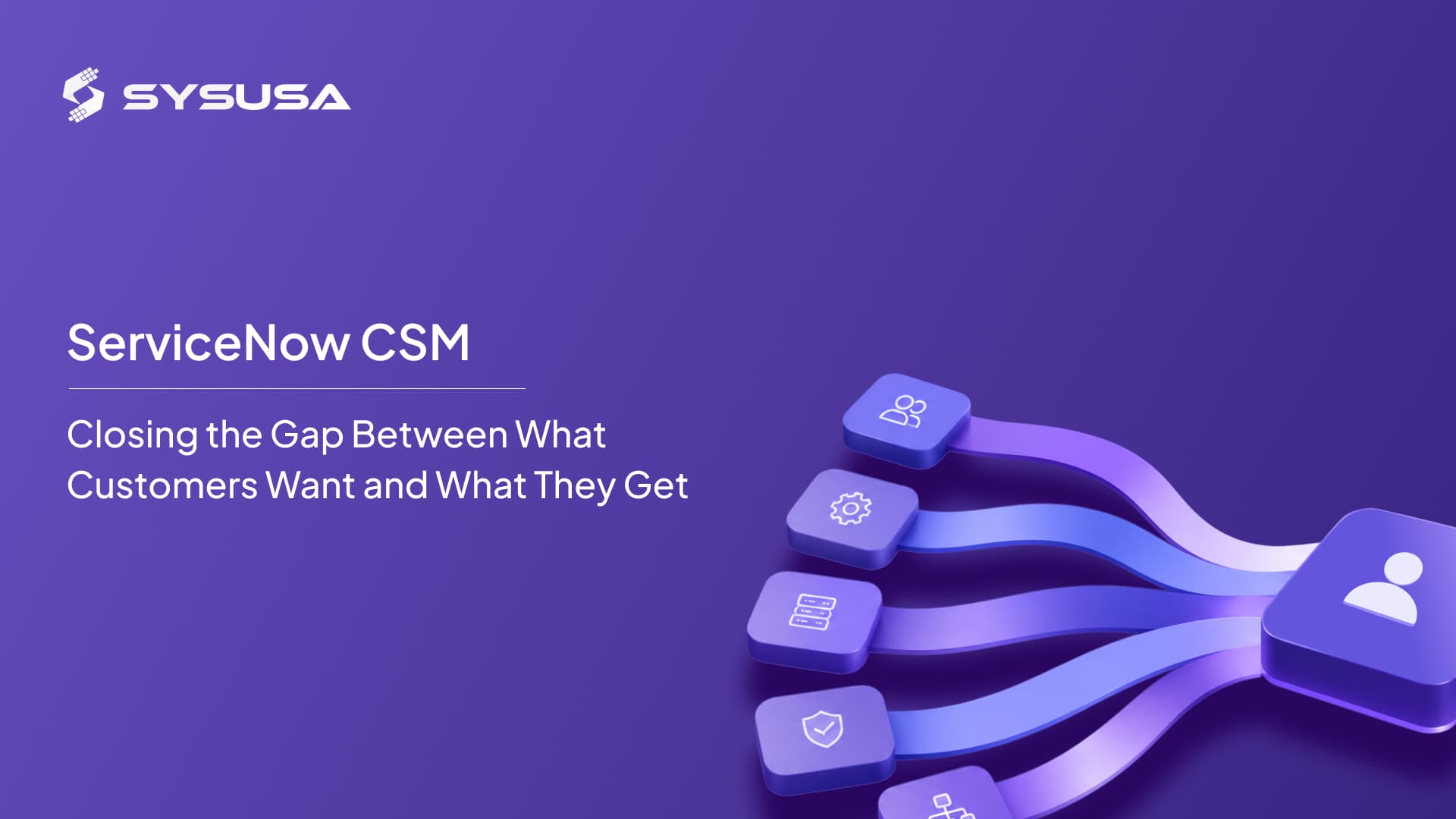
ServiceNow Customer Service Management is built around that plumbing problem specifically.
Where CSM picks up from CRM
The two terms are often used interchangeably, so it’s worth making the distinction clear. A CRM system, in ServiceNow's own framing, is a reactive tool. It tracks cases, stores customer information, and works well for sales and marketing teams engaging customers across channels. Where it runs out of road is the moment a customer's problem needs help from outside the customer service team itself, a billing dispute that needs finance, a provisioning issue that needs network operations, a compliance question that needs legal.
CSM picks up exactly there. It's the orchestration layer connecting customer service, middle office, back office, IT, and field teams so a request doesn't stall the moment it crosses a department boundary. A service catalog lets customers (or agents acting for them) kick off fully automated processes directly, resetting a password, changing a plan, requesting a statement, without needing a human at every step. And because case data, task status, and communication all live in one place, nobody has to explain their problem twice to two different departments.
In a KPMG survey of over 18,500 customers across 20-plus countries, high-quality service ranked just behind product quality as the top reason customers become loyal advocates for a brand. The Northridge Group has separately found that 73% of consumers are likely to switch brands entirely after one bad service experience. Good service isn’t a nice-to-have or just another cost. It plays a direct role in keeping customers, and getting it wrong comes at a price.
What's actually inside it
CSM is built around a handful of connected capabilities that share the same data model, rather than a collection of separate modules bolted together.
Case Management is the core: it orchestrates complex issues across departments using automated workflows, so a case that starts in the contact center and needs three other teams to close doesn't lose momentum, or its paper trail, at each handoff.
Self-Service handles the requests customers would rather resolve themselves. Conversational AI chat, personalized portals, service catalogs, and now AI Voice Agents let customers get answers and take action across whichever channel they picked, without waiting on hold for something simple.
Agent Workspace is where the human side of the job happens, a single configurable view across channels so an agent isn't hunting through five tabs to understand a customer's history. AI-generated case summaries, guided playbooks, and recommended actions sit right there, which matters more than it sounds: it's the direct fix for the toggling-between-systems problem the CX Shift research flagged.
Knowledge Management keeps answers current and easy to surface, with AI agents now able to draft and update knowledge articles and case summaries so human agents (and customers, through self-service) aren't relying on documentation nobody's touched in two years.
Predictive Intelligence is the proactive piece, using AI to anticipate what a customer is likely to need next, automate routine resolutions before a human ever sees the case, and cut overall case volume rather than just processing it faster.
And AI Agents run across all of it, handling routine tasks and completing entire processes autonomously, which is what lets a contact center scale coverage past normal business hours without proportionally scaling headcount.
A lost card, start to finish
A lost credit card is a good example of CSM in action, and walking through it shows why the department-crossing part matters more than any single feature.
A customer reports a missing card, or the fraud team flags a suspicious transaction first. Either way, a case opens and starts tracking every interaction and action taken from that point forward. The system automatically freezes the account and locks related cards to contain any damage immediately, before a human has necessarily even looked at the case. If transactions look suspicious, a second workflow spins up with tasks routed to the fraud and disputes teams, departments that have nothing to do with the original contact center interaction but now need visibility into it. The case gets triaged and monitored as it progresses, with responsible parties notified if anything stalls. Once resolved, the customer gets a clear close-out and a satisfaction survey, the account goes on a watch list for a period, and the whole thing leaves behind a complete audit trail.
Nobody re-explained the problem three times. Nobody had to manually chase the fraud team for a status update. That's the actual value of orchestration: not that any one step is clever, but that the case carries its own context through every handoff.
Keeping your contact center, not replacing it
A common and reasonable hesitation with any of this is the assumption that adopting CSM means ripping out an existing contact center platform. It doesn't have to. ServiceNow is built as an open platform designed to work with the contact center technology already in place, adding AI, automation, and cross-enterprise workflows on top of infrastructure that already works. The goal is to extend what’s already there, not force a complete replacement.
That openness has become much more apparent in recent months. ServiceNow and Salesforce jointly invested 1.5 billion US dollars in Genesys in August 2025, and ServiceNow has since broadened its partnership with Genesys specifically to integrate Genesys Cloud AI with the ServiceNow AI Platform. For an organization with real sunk costs and institutional knowledge tied to its contact center platform, building on what’s already there is a far more realistic path than starting over.
The bigger shift: Autonomous CRM
The biggest customer service development on the ServiceNow platform this year came at Knowledge 2026 in Las Vegas in May, where ServiceNow launched Autonomous CRM alongside a broader expansion of its Autonomous Workforce, with new AI specialists built to handle entire processes end to end, not just assist with individual tasks.
Each month, Autonomous CRM resolves over 100 million customer cases, orchestrates more than 16 million orders, and configures over seven million quotes, according to ServiceNow's own May 2026 announcement. CRM AI Specialists, covering sales qualification, quoting, order fulfillment, invoice disputes, service, and renewals, became generally available starting that same month.
Gartner's read on where this is heading doesn't hedge much: agentic AI is projected to be "an extinction level event for traditional CRM systems of record," with 90% of the market shifting to front-end autonomous agents by 2029. Whether that timeline holds is a fair thing to be skeptical about. What's harder to dismiss is the direction, since it matches exactly what the CX Shift research already found reps and customers struggling with today.
There's a real, working example behind the pitch. Bell, Canada's largest telecom provider, deployed ServiceNow AI Agents across customer case and complaint intake and saw a 25% improvement in customer response time, with case managers reporting 90% positive feedback on the AI's accuracy. Bell's own Chief Information and Customer Experience Officer, Hadeer Hassaan, credited the deployment with letting case managers spend time on actually complex cases instead of fixing data entry and routing errors by hand. It's a telecom-specific deployment, worth being precise about that, but the underlying mechanic (AI validating and routing cases before a human touches them) is the same one available inside standard CSM case management today.
Practically, this shows up inside CSM as ServiceNow Otto for Customer Service Management, the current name for what used to be marketed as Now Assist for CSM. It summarizes case information, drafts resolution notes, and summarizes chat interactions automatically, so an agent picking up a case mid-thread already has the context rather than reconstructing it.
What to expect from the Brazil release
ServiceNow's Brazil release reaches General Availability in early November 2026, following Early Availability in mid-September. A handful of CSM-specific changes come with it, a few genuine additions and three things being phased out.
Process Mining support for CSM gets meaningfully easier to set up. Previously, analyzing CSM case bottlenecks through Process Mining meant installing a separate content pack yourself. Starting with Brazil, that content pack becomes part of the core AI Platform and installs automatically alongside CSM, so upgrading to Brazil effectively switches on process-level visibility into case handling without a separate install step. The standalone content pack some customers already run stays active after upgrade but is no longer supported going forward.
Sentiment analysis in CSM, which scores case and email text to flag whether a case is trending positive, neutral, or negative, is documented for Brazil as predicting sentiment for cases created in English. Agents can use the score to prioritize their queue, and managers can route cases to agents with stronger empathy skills or catch cases heading toward escalation before they get there.
Case tasks now carry Account, Contact, Consumer, and Parent case fields on the task record itself, with a scheduled job available after upgrade to backfill those fields on existing active case tasks. The agent workspace, previously labeled uniformly as CRM Workspace, now names itself based on what's installed, CRM Workspace for CSM and CRM customers, industry-specific names for Financial Services or Public Sector instances. In Virtual Agent and Live Agent chats, a customer mid-conversation who tries to open a new topic now gets an explicit choice between continuing the current chat or starting a new one, rather than one behavior being forced automatically. For customers upgrading to Brazil, Engagement Messenger's embed code can also be modified to support language switching, instead of locking to whatever language was set at configuration. On the admin side, a new Prevent duplicate for account-contact business rule lets an administrator assign a contact multiple responsibilities on the same account without the system raising a duplicate error, and a Sitemap Generator configuration ships inactive in the base system for the Consumer Service Portal, letting admins turn on automatic sitemap generation for public knowledge articles and catalog items without custom development.
Work Scheduler, part of Workforce Optimization for Customer Service, is no longer deployed, enhanced, or supported as of Brazil. The Computer Telephony Integration (CTI) plugin is being prepared for deprecation, hidden on new instances and no longer activated by default, though still supported where it's already running. Communities follows the same pattern, hidden from new instances but still supported on existing ones. None of these break anything on upgrade, but any organization actively relying on Work Scheduler, CTI, or Communities should treat Brazil as the point to start planning a migration path rather than a surprise later.
What decides whether it works
None of this pays off automatically just because the applications are turned on. The service catalog only reduces agent load if it actually covers the requests customers make most often, not a generic template nobody customized. Agent Workspace only fixes the system-toggling problem if the integrations behind it are actually wired up to where a case's information really lives. And the AI agents summarizing cases and drafting resolutions are only trustworthy if the knowledge base feeding them is current, since an AI agent confidently drafting a resolution note from outdated documentation is a worse outcome than a slower human doing it correctly.
SYSUSA has spent more than a decade doing exactly that kind of implementation work across the ServiceNow platform, and CSM rollouts tend to follow the same pattern seen across every other product in this series: the configuration work behind the scenes decides whether the AI on top of it is actually useful or just a faster way to be wrong. If you're weighing CSM for the first time, or already run it and want a clear look at what Brazil changes for your setup, that's worth a conversation.