


Brazil reached early availability on September 24, 2026, and general availability on October 8, 2026. It is the second ServiceNow release named after a country, following Australia, and the release notes cover upgrades from Australia, Zurich and Yokohama.
Most of what is new sits with the people who build on the platform. Autonomous Engineer builds applications from requirements. Test Agent writes and maintains tests. AI Agent Studio has been rebuilt around a single canvas, and a new UI framework called Lux heads to general availability. MCP servers appear in more products, and several older features are retired or on their way out.
What are ServiceNow releases?
ServiceNow releases are twice-yearly updates to the platform that introduce new capabilities, enhance existing functionality, and address product fixes. These releases are intended to improve the platform while giving organizations access to new modules, applications, and features. Between versions, ServiceNow ships numbered patches and hotfixes with fixes and security updates. Brazil Patch 0 arrived on September 24. Australia Patch 6 and Zurich Patch 12 both shipped on September 10.
Moving to a new release is not simply a matter of applying the update. It requires planning, testing, and validation to understand how the changes will affect your instance. New functionality can also introduce changes that need to be evaluated alongside your existing configurations and customizations.
As part of an upgrade, updates are applied to features included in the base platform and those already active on the instance. Where those features have been customized, additional review may be needed to determine whether the customizations are still compatible with the new release.
Why are the releases named after countries now?
Release names ran alphabetically from Aspen in 2011 to Zurich in 2025. After Zurich, ServiceNow started a sequence of country names. Australia came first, with early availability on March 12, 2026 and general availability on May 5, 2026. Brazil is second. Australia landed in Q2 and Brazil landed in Q4.
When is the Brazil release available?
Early availability: September 24, 2026
General availability: October 8, 2026
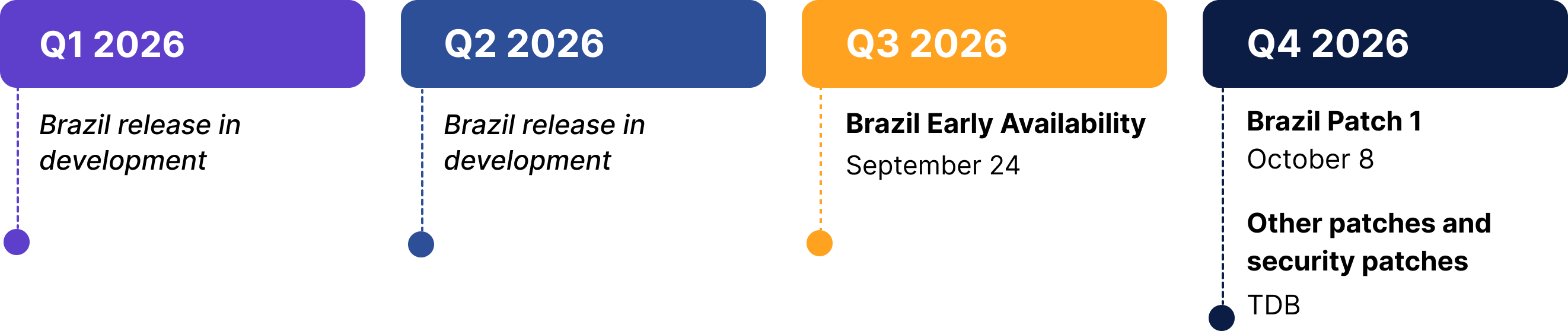
Before each general availability, customers can join the Early Release Program. Release Testing Preview begins at least 60 days before general availability and lets teams upgrade sub-production instances to a pre-release build. Early Availability is the second phase. Active customers and partners register through the Early Release Program Registration item in Now Support. Brazil's Early Availability began on September 24.
Why does the Brazil documentation say Otto?
ServiceNow Otto is the new name for the platform’s AI experience layer, bringing Now Assist, Moveworks and AI Experience together on a single AI-native architecture. The Brazil release introduces the name across products, including IT Service Management and Virtual Agent, while keeping product entitlements unchanged. If your team currently uses Now Assist, look for the same capabilities under the Otto name.
What does Brazil add for builders and developers?
Build Agent and Autonomous Engineer
Build Agent is ServiceNow's AI agent for building and editing applications from natural-language prompts. Brazil adds custom rules and skills, background scripting tasks, a choice of AI models, and playbook generation.
The larger addition is Autonomous Engineer. ServiceNow describes it as an agentic worker that takes specifications as input and drives implementation end to end inside ServiceNow Studio. It accepts requirements as a PDF or through an MCP connection to an agile tool. Where requirements are vague, it asks questions. It checks which tables and configuration already exist on the instance, then builds work items in parallel using background agents. For each work item it generates and runs Automated Test Framework (ATF) tests. The output is a batch update set. It does not push to production, and when two requirements contradict each other it parks the item in draft and asks a person.
Autonomous Engineer launches through the new AI Workflow Factory for the Prime SKU. ServiceNow said a free tier for Personal Developer Instances is coming. The app installs from the ServiceNow Store, so check your entitlements first.
Test Agent and automatic test maintenance
Test Agent generates ATF tests for code that Build Agent produces, runs them, and performs root cause analysis on failures. Auto Test Maintenance detects drift when an application changes. It updates the tests that still apply, writes tests for new features, and removes tests whose logic no longer exists. In ServiceNow's demo, a food truck app gained a menu item and lost a promotion. The agent updated the UI tests and deleted the promotion tests. It works best on Fluent apps. Native apps work too, with more descriptive prompts.
ServiceNow Studio
Studio gets an agent-first homepage built around Build Agent, an Open in Studio option on platform records, and a right-click configure menu that routes straight into Studio. A source Explorer brings ServiceNow IDE capabilities into Studio, and Source Control V2 links an app to an external repository for staging, syncing and pushing. The IDE remains a standalone product.
One caution from the Studio session: converting an app to Fluent currently limits access to admin users. That matters for teams running delegated development. ServiceNow said non-admin access is on the roadmap.
Now SDK and Fluent
Fluent gains five APIs: RestMessage, Alias, AliasTemplate, RetryPolicy and DataLookup. A new Now.del() function handles record deletion declaratively. The SDK adds three CLI commands: now-sdk cicd, now-sdk query and now-sdk explain.
Developer Sandboxes
Setup moves into a Developer Sandboxes tab in the App Engine Management Center, so admins no longer file a ticket with ServiceNow support. Every customer gets a free trial pack, and the cap is three packs per instance for now. Brazil keeps a warm pool of sandboxes running, so allocation is immediate. Before, it took between 15 minutes and an hour. The pool refreshes against the base instance every 24 hours. Creating a sandbox sets up remote update sources on both sides, and REST APIs cover creating, listing and retiring sandboxes. ServiceNow's advice is to keep sandboxes short-lived, one per story or defect, for a day or two.
Flow debugging
The Flow Debugger gains Input Modification. A developer can change a step's inputs mid-execution, force an if-condition down either branch, or cap a lookup, all within one run. It covers flows and subflows with standard input types, not scripts or arrays. It lives in the new Flow Designer UI, which you opt into.
The second addition is a Flow Troubleshooting Agent. It investigates a misbehaving flow and returns a summary, a root cause and next steps. The first release covers approvals and triggers. It respects access controls and requires Otto. It is not yet available on Personal Developer Instances.
What is Lux, and does it replace Service Portal?
Lux is ServiceNow's new AI-native UI framework. ServiceNow said it did not want to keep building on Angular 1 and Bootstrap 3.3.1. Lux uses LIT, Base UI and Tailwind CSS. One shell handles navigation, home, search and notifications, and apps and workspaces load inside it. AI Control Tower and the EmployeeWorks web app already run on Lux, and so does the new Studio homepage. Developers can build with Lux Lab or Lux Lab for VS Code, both on top of the Now SDK.
Lux reaches general availability in Q4 2026, when full documentation and Personal Developer Instance access are also due. ServiceNow said it has no plans to deprecate Workspaces or Angular Service Portals. It is evaluating a move of requester experiences on Service Portal to Lux, not before early 2027. The base framework is a platform feature for everyone. The AI features on top depend on your SKU.
How do AI agents change in Brazil?
AI Agent Studio. The redesign puts agents, tools and workflows on one canvas. Versioning now covers the whole agent or workflow, where before it covered only the instruction text. A single click generates an update set, though tools are not included in it. Testing and evaluation connect to AI Agent Advisor. The release notes add detection and disabling of runaway agent triggers, deny-by-default access control for agentic record types on newly activated instances, and issue tracing with suggested optimizations. The new experience is on by default, and the legacy studio is one click away. Agents can run on Claude, Gemini, Azure OpenAI or ServiceNow's own model, billed through ServiceNow. Bringing your own key means paying the provider and paying again through Otto consumption. The release notes also add Gemma 4 to the Now LLM Service.
Playbooks. Three capabilities arrive. Conversational playbooks expose a playbook in chat through a skill with a label, a description and a target assistant. Playbooks can act as MCP tools, so external AI tools such as Claude or ChatGPT can call them. ServiceNow said it is working to remove the current restrictions on activities and fields in that feature. Hybrid agentic activities place an AI agent inside a form-based activity, in a collaborative mode that asks permission before saving or an autonomous mode that completes the work.
Intelligent Approvals. The feature reads a policy document, either a PDF or a knowledge article, and turns it into approval logic. At runtime each request ends in one of three outcomes: auto-approve, auto-reject, or escalate to your existing approval workflow. In ServiceNow's demo, a normal low-risk change approved itself in seconds, while an emergency high-risk change went to a person with a note explaining why. Once a decision is made, nobody can override it. Building and testing a policy costs no Now Assist credits, and each automated decision after publishing costs 25.
Governance and administration. AI Control Tower adds AI asset usage policies that respond to detected threats or block an agent, domain or model outright. It connects to Azure AI Foundry so policies and agent containment can reach agents running there. It adds an AI Inventory Intelligence Agent that finds assets with incomplete metadata, and it lets you set evaluation metrics for individual AI systems without changing global settings. AI Admin Center, formerly Now Assist Center, and AI Agent Advisor gain automation opportunity enhancements, including quick-select filters and matches to default AI agents. Autonomous Workforce AI specialists can now read attachments such as screenshots, PDFs and error logs, and each specialist gets a configurable name, icon and role.
Where does MCP show up in Brazil?
The Model Context Protocol appears in several places in the release notes:
MCP Server Console embeds OAuth client registration in its wizard and supports annotations so clients such as Claude can apply the right permission policies. It also adds MCP apps and a quickstart server for looking up incidents and cases.
ITSM MCP Server covers incidents, change requests, request items and on-call scheduling.
ITOM MCP Server Console lets teams act on alerts and review CI reliability from an MCP client.
MCP for Strategic Portfolio Management exposes eight tools for querying goals, portfolio plans and projects.
Contract Management Pro MCP Server delivers AI-proposed redlines that follow your approved playbooks.
Authentication lets you register an external authorization server, such as Microsoft Entra ID or Okta, as a trusted token issuer for the MCP Server.
What changes by workflow?
IT Service Management. Change Management adds compliance dynamic schema, which stores risk and compliance details without new columns on the change request table. It also adds change lockdown, which lets change managers pause all or a subset of in-flight changes, along with change lockdown conflict detection and Scaled Change for environments with many configuration items. Employee Slate for ITSM adds Tech Lounge services, with walk-in queues, appointment booking and conversational booking through Otto.
IT Operations Management. Certificate Inventory and Management extends ACME support to DigiCert and Sectigo certificate authorities and can store private keys in CyberArk PVWA. Discovery can prefer PowerShell 7 on the MID Server and on remote hosts, and Discovery Admin Workspace adds a Kubernetes explorer dashboard. ITOM AIOps adds a Dynatrace Grail connector that creates alerts from problem events, and it shows the reasoning and supporting evidence behind each alert the AI auto-closes.
Security and data protection. Authentication adds federated identity for outbound connections to Microsoft Azure and Google Cloud Platform, a Basic Authentication restriction page with a tracking period before enforcement, identifier-first login policies, and banner alerts when SAML signing or encryption certificates near expiry. Code Signing generates signatures automatically when application files are committed to source control and records audit data on protected records. Encryption Key Management adds a Unified Secrets Gateway API. Container Vulnerability Response adds two chained Wiz integrations for image-grouped findings and deployment context.
Strategic Portfolio Management and Collaborative Work Management. Hybrid project management connects Project Workspace and CWM, with updates syncing between them. Otto generates CWM tasks and stories from prompts or uploaded files, and child tasks from the List view. Every Board gets a Dashboard tab with predefined Team progress and Team sprint tracker dashboards, and CWM adds Lists. Goal Framework for SPM calculates target status as Green, Yellow or Red from actual achievement against configurable thresholds.
Customer and sales workflows. Customer self-service for Sales CRM adds Sales Cart REST APIs, so third-party consumer portals, partner portals and headless ordering applications can create and submit carts. It extends digital ordering to B2C consumers and lets customers view contracts and entitlements on the Business Portal. Customer Success Management adds AI-generated success plays and a daily AI-generated engagement brief.
Finance operations. Accounts Payable Operations adds case exclusion rules that keep unneeded emails from creating cases, and agents can reopen a closed inquiry case to reuse its history.
What is deprecated or removed in Brazil?
Now LLM Service: older models stay available for existing published skills, agents and agentic workflows, and are no longer available for new development.
ServiceNow Studio: the Experience switcher, Tools tab, top-right Create menu and Resources section are removed.
Virtual Agent: Virtual Agent for NLU and Virtual Agent Lite, plus the pre-built ITSM Virtual Agent topics, are being prepared for future deprecation. They stay supported but will be hidden and not activated on new instances. The Alexa, Amazon Connect IVR and IBM Watson channel integrations are on the same path.
CMDB: CMDB Baseline is being prepared for future deprecation, with Unified Map as the current experience. The itil role is removed from the app_service_admin role.
Project Portfolio Management: the Planning console is deprecated. Use Project Workspace.
Service Catalog: catalog roles no longer grant access through request management ACLs.
Discovery: findOrCreateRelationshipType no longer creates relationship types, as of Brazil and recent Zurich and Australia patches. Scripts should use findCIRelationshipType.
ITOM AIOps: the classic Dynatrace event integration is replaced by the Grail connector.
Communities: no new activations.
Which Brazil features depend on your licence?
Autonomous Engineer: AI Workflow Factory, for the Prime SKU.
AI Agent Studio: Pro Plus or an AI SKU.
Intelligent Approvals: Now Assist for Platform (Pro Plus), AI Platform Advanced, or Prime for live decisions.
Flow Troubleshooting Agent: Otto, available with Now Assist for Platform.
Lux: the base framework is open to everyone. The AI features depend on SKU.
How should you plan the upgrade?
Start with the release notes for your path: Australia, Zurich or Yokohama to Brazil. If you skip families, use the combined product release notes. ServiceNow lays out the upgrade in seven phases:
Read the release notes and plan the upgrade.
Prepare the development instance.
Verify upgrade configurations and schedule the development upgrade in Now Support.
Upgrade and validate the development instance.
Upgrade and validate other non-production instances.
Prepare the production upgrade.
Upgrade production.
Brazil has been on Personal Developer Instances since September 24, which gives developers a place to test changes before they reach your own instances. ServiceNow recorded eleven Developer Passport sessions covering the release, and recaps are on the Community.
On support: ServiceNow covers the most recent family and the one before it. With Brazil now generally available, Australia is the previous release and Zurich falls two families back. ServiceNow's community version table lists end of life at 60 days after general availability, and lists Yokohama's end of life as Q4 2026. Confirm your own instance dates in Now Support.
FAQs
When is the ServiceNow Brazil release available?
Early availability began on September 24, 2026. General availability followed on October 8, 2026.
Can I upgrade from Zurich to Brazil?
ServiceNow publishes release notes and combined product release notes for upgrades from Zurich, as well as from Australia and Yokohama.
Is Brazil available on Personal Developer Instances?
Yes, since September 24. When ServiceNow presented them, the Flow Troubleshooting Agent was not yet on Personal Developer Instances and the free tier of Autonomous Engineer was still to come.
Does Lux replace Service Portal?
ServiceNow said it has no plans to deprecate Workspaces or Angular Service Portals. It is evaluating Lux for requester experiences on Service Portal, not before early 2027.
What is ServiceNow Otto?
Otto is the name of ServiceNow's AI experience layer. It brings together Now Assist, Moveworks and AI Experience, and ServiceNow says the rename does not change how existing AI features work.
If you are planning your Brazil upgrade, our team can review your current instance, flag the deprecations and licensing limits that affect you, and help you build an upgrade plan that fits your timeline.