
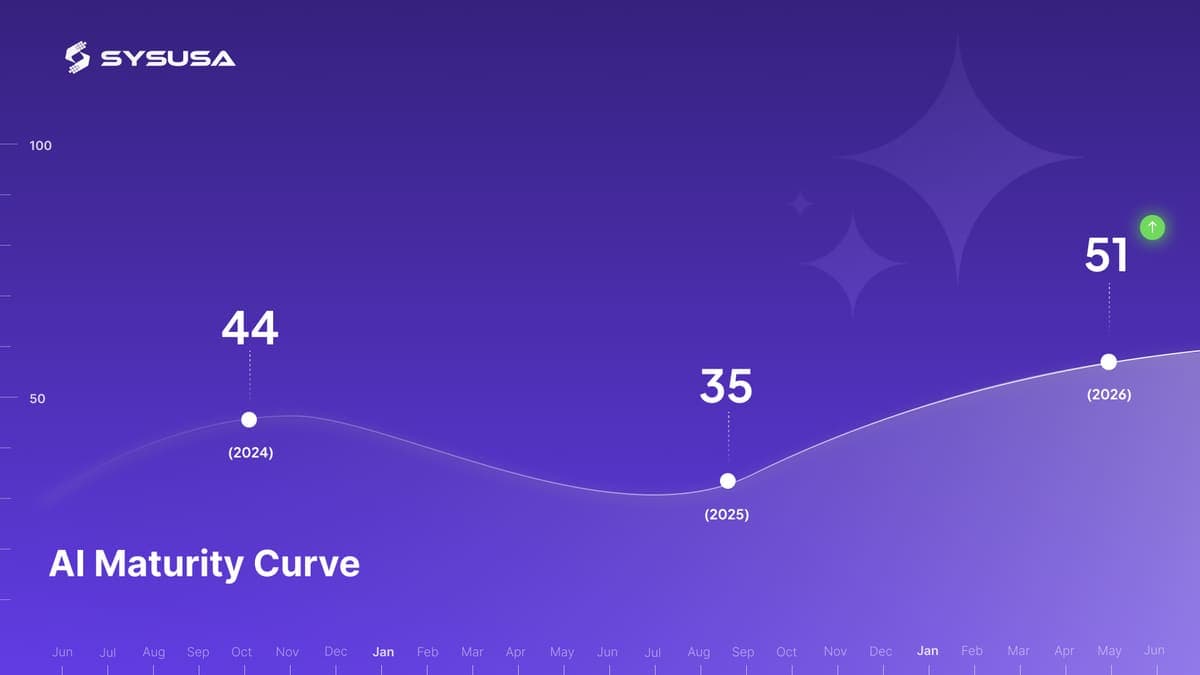

Most organizations believe they are further along on AI than the data suggests. Executive confidence in AI has rebounded sharply in 2026. AI investment grew 110% in a single year. And yet, when ServiceNow and independent research firm ThoughtLab surveyed 6,500 executives and employees across 19 countries, the average AI maturity score came in at 51 out of 100. AI-enabled workflows, the pillar that most directly determines whether AI produces business outcomes rather than isolated demos, scored the lowest of all seven dimensions at just 40.
The gap between what organizations think is happening and what is actually happening is where most AI investment disappears.
The four-stage AI maturity model ServiceNow uses to classify enterprise organizations offers a useful frame for understanding what separates each stage and where your organization actually stands.
What is the AI Maturity Curve?
The AI maturity curve is a four-stage progression that describes how organizations move from early AI experimentation to full business reinvention through AI. The stages are Experimenter, Scaler, Advancer, and Transformer. Each stage has a distinct set of capabilities, challenges, and ROI outcomes.
Derived from self-reported data across thousands of organizations and validated against financial performance, workflow integration, governance maturity, and workforce readiness, it is a grounded classification rather than a conceptual one. What an organization scores on that model determines, with a high degree of reliability, what kind of AI outcomes it can expect.
The most important insight the research surfaces: The organizations pulling ahead are not the ones with the most advanced AI models. They are the ones with the infrastructure to execute reliably at scale.
Stage 1: Experimenter
Average AI maturity score: 20 to 39
Average AI ROI: 125%
Experimenters are in the planning phase. Most are running AI pilots in individual departments and building the internal case for broader investment. Very few have replaced fragmented legacy systems, and business cases for AI initiatives are largely undeveloped.
The defining characteristic of this stage is that AI operates inside siloed applications rather than across the business. An AI tool in IT does not connect to one in HR. A pilot that succeeds in one department cannot be replicated in another because the data, workflows, and governance that would allow replication are not in place.
The three challenges organizations at this stage consistently report: choosing the right vendors for their specific needs, integrating with legacy systems, and managing AI risks and ethical concerns without formal frameworks.
What the move to Scaler requires:
Governance built before deployment, not after. Organizations that try to add governance once AI is already running find it acts as a brake rather than an accelerator. Data governance policies covering ownership, quality, and access need to be established before pilots expand. The other essential move at this stage is identifying the fragmented, manual processes consuming the most time and starting to build the business case to retire them. Task-level automation is the entry point, not the endpoint.
Stage 2: Scaler
Average AI maturity score: 40 to 59
Average AI ROI: 145%
Scalers have moved from planning to implementation. They have begun addressing data, governance, and skills gaps, and they are deploying AI across the organization rather than just in isolated pilots. Most still have siloed legacy systems and traditional workflows, and cross-functional AI integration remains limited.
The research is specific about what stalls organizations at this stage: unclear AI ROI, siloed data, and insufficient human oversight on AI actions. These are not technology problems. They are architecture and governance problems. Organizations at this stage typically have AI tools working within individual departments but no coherent layer coordinating those tools across functions.
What the move to Advancer requires:
Data orchestration, not just data collection. The difference between Scalers and Advancers is that Advancers have moved beyond accumulating data to standardizing it: cleaning, tagging, integrating diverse formats in real time, and building the infrastructure that makes data reliable rather than just accessible. Scalers that skip this step find themselves unable to scale autonomous workflows, because AI agents without clean, connected data return partial answers and inconsistent results. The other defining move at this stage is formalizing a governance team with defined roles, policies, and oversight procedures, with audit practices embedded into autonomous workflows rather than bolted on afterward.
Stage 3: Advancer
Average AI maturity score: 60 to 79
Average AI ROI: 159%
Advancers have strong foundations. Data systems are largely modernized, governance is in place, and AI vision is clear. They are actively deploying agentic AI to optimize existing workflows across the enterprise and beginning to see meaningful productivity gains as a result.
The challenges at this stage shift from infrastructure to ambition. Potential job loss and employee resistance emerge as top concerns, and the AI skills gap becomes more specific: Advancers need people who can design orchestrated workflows, interpret AI-driven decisions, and manage human-AI collaboration at scale, not just people who can use AI tools.
The research shows that Advancers are 5.6x more productive than organizations at lower maturity stages, but they have not yet achieved the business model reinvention that Transformers pursue. The shift from departmental automation to enterprise-wide orchestration is the defining transition of this stage.
What the move to Transformer requires:
Evolving governance from operational oversight to strategic accountability. At this stage, governance frameworks should be mature enough that others benchmark against them. The AI value question also changes: Advancers are still focused on efficiency and cost reduction. Transformers measure value by what new markets, products, and revenue channels AI makes possible. Organizations at this stage need to start prioritizing AI use cases that reshape the business model, not just optimize existing workflows.
Stage 4: Transformer
Average AI maturity score: 80 to 100
Average AI ROI: 210%
Transformers are rare. They represent approximately 4% of organizations surveyed, and they are setting the terms for what AI-first operations actually look like in practice. They have moved decisively past efficiency and automation into new territory: creating new customer segments, launching new products, and driving competitive repositioning through AI.
The performance data reflects that ambition: 210% average AI ROI, 88% increased customer engagement and retention, 87% accelerated time to value, and 84% reduced operational risk. These outcomes follow from a different organizational model, one where AI is central to strategy, operations, and value creation simultaneously. Transformers use AI to orchestrate work across the enterprise rather than assist individuals within it, and they have redesigned how humans and AI work together rather than deploying AI into structures built for a pre-AI era.
What is a Pacesetter?
The research uses a specific term for organizations scoring above 60 on the maturity index: Pacesetters. They represent 21% of organizations surveyed and include both Advancers and Transformers.
What defines a Pacesetter is not budget or industry. It is a fundamental decision about how AI fits into the enterprise. While most organizations deploy AI into existing structures, Pacesetters build their organizations around AI. That structural choice is what compounds with every deployment that follows.
Pacesetters are:
- 6.5x more likely to use AI to improve or create new products, services, and revenue channels compared to non-Pacesetters.
- 5.6x more productive.
- 2.7x better at scaling AI across the organization.
- 2.6x better at reducing risk.
- 2.6x better at employee engagement and retention.
They achieve an average ROI of 194% within two years, compared to 125% for Experimenters.
The gap between Pacesetters and the rest is widening. It compounds with every AI deployment the leaders make and every deployment followers delay.
The five things Pacesetters do differently
The research identifies five strategies that consistently separate Pacesetters from organizations stuck at lower maturity stages, each with documented adoption rates that make the gap between groups concrete rather than abstract.
1. Shared vision, not top-down mandate
71% of Pacesetters communicate AI vision widely across the entire organization, compared to 29% of others. 72% build AI mindsets before they build deployments. For Pacesetters, strategy is a shared direction backed by implementation plans tied to defined outcomes, not a document issued by leadership.
2. AI-ready data
64% of Pacesetters use digital technologies to integrate and optimize data, compared to 14% of others. They treat data modernization as a strategic prerequisite, not an IT project. The result is an enterprise where AI has access to the right data, in context, at the moment it needs to act.
3. Orchestration over automation
61% of Pacesetters implement AI across a wide range of departmental workflows, compared to 5% of others. 58% streamline and integrate workflows across business functions, compared to 5% of others. The distinction Pacesetters draw is between automation, which makes individual tasks faster, and orchestration, which coordinates AI agents, data, and decisions across the entire enterprise.
4. Workforce investment
68% of Pacesetters build strategies to attract, develop, and retain AI talent, compared to 10% of others. 57% launch change management programs, compared to 7% of others. Pacesetters understand that AI transformation does not happen to an organization. It happens inside one.
5. Governance built before deployment
69% of Pacesetters embed trust and transparency into AI processes, compared to 16% of others. 61% implement AI testing, auditing, and risk assessment processes before scaling, compared to 10% of others. For Pacesetters, governance is what enables acceleration. It is not what constrains it.
How to assess your own maturity stage
The research measures AI maturity across seven pillars: vision and leadership, management and culture, data modernization, AI governance, talent and skills, AI-enabled workflows, and driving value from AI.
A practical self-assessment starts with the pillar that scored lowest across all organizations in the research: AI-enabled workflows at 40 out of 100. Ask:
How many of your AI deployments are isolated within a single department versus connected across functions? If the answer is most or all, you are likely operating at the Experimenter or Scaler stage regardless of how many AI tools you have purchased.
How often do AI agents in one part of your organization rely on data generated by another part? If the answer is rarely, the data architecture that agentic AI requires is not in place.
When an AI deployment fails or produces unexpected output, do you have audit trails that let you trace why? If not, governance is reactive rather than structural.
What percentage of your AI spend is on tools versus on the infrastructure and processes that allow those tools to deliver enterprise-wide results? Organizations spending heavily on tools but lightly on architecture are almost always Scalers, regardless of how their executives describe their AI maturity.
The research is direct about what the data shows: most organizations are using AI to do the same work slightly faster. The more transformative applications, creating autonomous multistep workflows, connecting AI across business functions, and generating entirely new capabilities that were previously impossible, remain out of reach for the vast majority. Only 9% of organizations surveyed have made meaningful progress building autonomous multistep workflows. Zero percent have built a cross-functional, self-improving agentic operating system.
The research frames this as a deployment gap, not a technology one, and describes it as closable.
What this means practically
Knowing your maturity stage matters because the right next move depends entirely on where you actually are.
An Experimenter trying to deploy enterprise-wide AI orchestration before data governance and integration are in place will generate agent sprawl, not business outcomes. A Scaler that rushes to agentic AI before retiring siloed legacy systems is adding a new wave of fragmentation on top of existing fragmentation. An Advancer that spends the next two years optimizing existing workflows rather than asking whether those workflows should exist at all is automating yesterday's work instead of building the organization that tomorrow requires.
The foundation you build now determines the returns you realize next. Organizations that invested early in cloud and API governance paid a one-time architectural cost. Those that didn't pay repeatedly, at increasing scale, and usually at the worst possible moment. End-to-end AI orchestration is that same inflection point.
Taking it seriously is the baseline. Taking it at the right stage is what determines the return.