

AI investment grew 110% in a single year. By 2027, it is projected to represent more than 20% of the average organization's IT budget. And yet, when ServiceNow and independent research firm ThoughtLab surveyed 6,500 executives and employees to measure what that investment is actually producing, one finding stands out: only 9% of organizations have made meaningful progress building autonomous multistep workflows. Most are paying for a capability they have not yet unlocked.
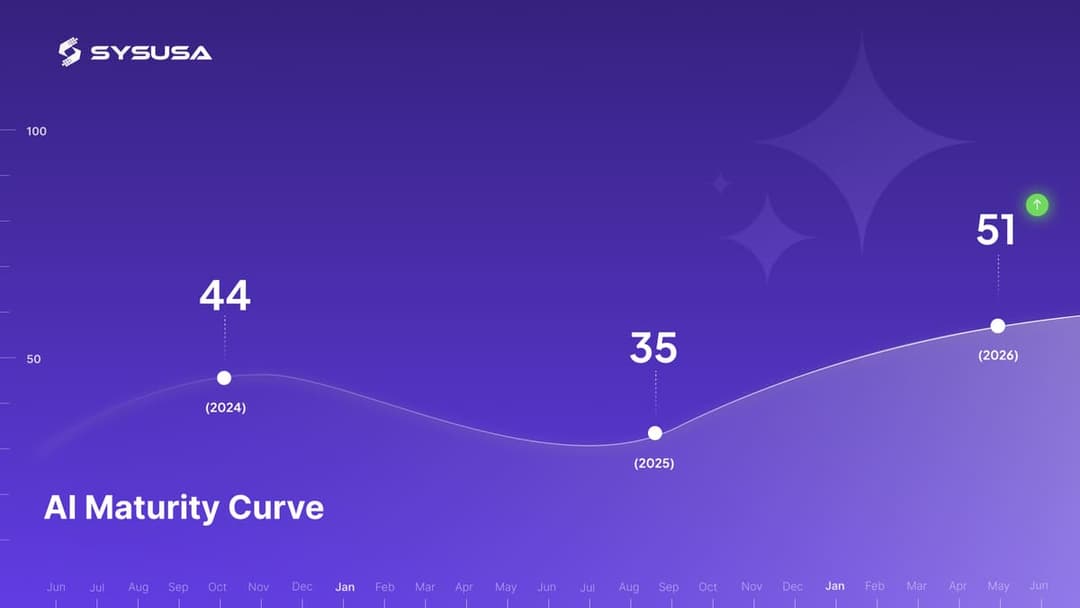
The organizations that are unlocking it share specific, documentable characteristics. The research calls them Pacesetters. They represent 21% of organizations surveyed, average a maturity score of 74 out of 100 versus 45 for everyone else, and achieve 194% ROI within two years compared to 125% for the least mature organizations. That gap is not explained by budget, industry, or geography. It is explained by decisions about architecture, governance, and how AI fits into the enterprise.
The five decisions that define Pacesetter organizations are specific, measurable, and documented with adoption rates that make the gap between groups concrete.
What most organizations are actually doing with AI
Before looking at what Pacesetters do differently, it is worth being precise about where most organizations are.
59% of organizations are now using agentic AI in some form. That number has grown faster than almost any adoption curve in the study's three-year history. A year ago, 71% of executives said they were not very familiar with agentic AI. The shift from unfamiliar to widespread in twelve months is unusually fast.
But adoption and execution are not the same thing. 41% of organizations are using AI agents to assist individuals, which is useful, but a long way from autonomous. Only 5% are redesigning work, as opposed to using AI agents to automate existing workflows. Zero percent of organizations surveyed have built a cross-functional, self-improving agentic operating system.
The structural problem is visible in the data. Only 16% of organizations have widely or fully replaced fragmented legacy systems with an integrated platform. The rest are deploying AI on top of disconnected architectures and expecting end-to-end results. When information is scattered across business units, AI fails to get the complete, real-time view it needs to act reliably. Use cases stay isolated and hard to scale. Early wins remain fragile and difficult to replicate beyond individual departments.
The pattern is consistent: organizations that bolt AI onto fragmented systems get fragmented outcomes. The investment grows. The results don't.
What Pacesetters are doing instead
What separates Pacesetters is infrastructure, specifically the architecture and processes that make each AI deployment build on the previous one rather than add to existing fragmentation.
The research identifies five practices that consistently separate Pacesetters from the rest. The gaps in adoption rates are substantial, not marginal.
They set a vision that the whole organization can execute against
57% of Pacesetters set a shared strategic vision for AI beyond efficiency gains, compared to 21% of others.
The distinction matters because vision without organizational alignment does not change behavior. Pacesetters communicate their AI vision widely across the organization (71% versus 29% of others), back it with implementation plans and defined outcomes (70% versus 17%), and build AI mindsets before they build deployments (72% versus 34%).
For Pacesetters, strategy is a shared direction, not a document. They define AI responsibilities across every level of the organization, from C-suite to frontline, and create the conditions for people to reimagine how work gets done rather than just deploying tools into existing structures.
The practical implication is that AI transformation does not happen to an organization. It happens inside one. Organizations where AI strategy lives primarily at the executive level find that it stops there.
They treat data as a strategic prerequisite
64% of Pacesetters use digital technologies to integrate and optimize data, compared to 14% of others.
This is the most underappreciated differentiator in the research. 41% of employees rank data silos among their organization's biggest AI mistakes. 71% of executives cite inadequate data accuracy, access, and management as the number one challenge to AI adoption. The most sophisticated AI agents still cannot reason, act, or reliably execute across an enterprise if the data supporting them is fragmented, siloed, or out of date.
Pacesetters treat data modernization as a strategic prerequisite, not an IT project. They replace legacy systems with integrated platforms, establish clear policies for data ownership and control, and use AI itself to improve how data is migrated, created, and managed. The resulting architecture gives AI the right data, in context, at the moment it needs to act rather than access to a fragmented pool of stale records.
Every interaction, every workflow, every data point adds enterprise context that makes AI more precise and organizational decisions more reliable over time. This compounding effect is what separates organizations where AI improves with use from organizations where AI plateaus after initial deployment.
They orchestrate rather than automate
61% of Pacesetters implement AI initiatives across a wide range of departmental workflows, compared to 5% of others. 58% streamline and integrate workflows across business functions with AI, compared to 5% of others. 36% use agentic AI to create autonomous multistep workflows, compared to 2% of others.
The gap between automation and orchestration is worth being precise about. Automation makes individual tasks faster, one problem at a time, one tool at a time, one department at a time. Orchestration is the layer that coordinates AI agents, data, and decisions across the entire enterprise. Individual tasks get faster with automation. The enterprise stays fragmented. With orchestration, routine coordination, routing, and execution are handled by AI, and human judgment, creativity, and decision-making move to the center.
Pacesetters reject the automation model. They embed AI across departments, connect it across functions, and keep going until routine work runs itself, not as a set of disconnected tools, but as a governed layer that operates at enterprise scale.
The outcome difference is substantial. Organizations that have crossed from automation to orchestration are 5.6x more productive than those that haven't.
They invest in the workforce, not just the technology
68% of Pacesetters build deliberate strategies to attract, develop, and retain AI talent, compared to 10% of others. 57% launch change management programs, compared to 7% of others. 58% build long-term HR plans specifically designed to support AI strategy, compared to 5% of others.
This is where the employee-employer disconnect matters most. Employees are significantly more likely than executives to believe AI will improve their job satisfaction, enable higher-value work, and strengthen collaboration. They are also far less worried about the downsides.
Executives are consistently overestimating cultural resistance and underestimating workforce readiness.
Organizations that stay in touch with employee sentiment can move faster, with more confidence and more workforce alignment behind their AI investments. Pacesetters build organizations where people and AI are ready to work together at scale. The results show in retention: Pacesetters are 2.6x better at employee engagement and retention than others.
59% of organizations do not have long-term HR plans to support the future of work. 42% of employees say they are not getting enough AI training. Only 21% of organizations have assessed AI skills across the enterprise. Each of those figures represents organizational readiness, and organizational readiness determines how much of any AI investment actually reaches its intended outcome.
They build governance before they need it
69% of Pacesetters embed trust and transparency into AI processes, compared to 16% of others. 61% implement AI testing, auditing, and risk assessment processes, compared to 10% of others. 54% say organizations need a security-first approach when developing AI solutions.
The reason governance is a differentiator rather than a baseline is that most organizations still treat it as a compliance activity rather than an operational one. Only 20% of organizations surveyed have implemented AI testing, auditing, and risk assessment processes. As AI takes on more decision-making, the absence of clear governance frameworks amplifies the risk of each deployment.
Pacesetters treat governance as a competitive advantage. They build living processes: continuous regulatory scanning, ongoing risk assessment, and systems that track compliance and accountability across the enterprise. As agents assume greater decision-making responsibility, Pacesetters establish cross-functional oversight that defines standards and intervenes when risks emerge.
Autonomous does not mean unattended. The organizations that move fastest on AI have defined, in advance, exactly where human judgment begins, which is what allows them to scale without losing control.
Organizations that invested early in cloud and API governance paid a one-time architectural cost. Those that didn't pay repeatedly, at increasing scale, and always at the worst possible moment. AI orchestration infrastructure is that same inflection point. Most enterprises are underestimating how early they need to make the call.
Why the ROI gap will keep widening
The Pacesetter advantage compounds with each investment cycle.
Every deployment a Pacesetter makes builds on connected data, governed workflows, and organizational capability that already exists. Every deployment a less mature organization makes adds to a fragmented architecture that makes the next deployment harder rather than easier. The gap between a 74 average maturity score and a 45 average maturity score does not narrow on its own. It widens with each investment cycle.
The research is direct about the two-year outlook. Only 20% of organizations expect to be using agentic AI to create autonomous multistep workflows within two years. As AI capabilities accelerate, organizations still running on outdated workflows will find themselves falling further behind on productivity and unable to deliver the new products and services that AI makes possible.
The Pacesetter ROI figures are not an argument for moving fast. They are an argument for moving with the right foundations. An AI agent deployed on broken infrastructure can become a dangerous liability. Connected agents amplify each other's errors as readily as they amplify each other's value. Complexity compounds faster than most organizations anticipate, and by the time it becomes visible, the cost to correct is significant.
What the data means for your AI strategy
The research does not segment Pacesetters by industry, region, or company size. It defines them by how AI fits into the enterprise: whether it is deployed into existing structures or whether the organization is built around it.
That is a decision available to any organization regardless of where it is starting from. The gap between where most organizations are and where Pacesetters operate is wide, but the research describes it as closable.
The five strategies are sequential in an important sense. Vision without data readiness produces pilots that cannot scale. Data readiness without governance produces AI that cannot be trusted. Governance without workforce investment produces capability that cannot be absorbed. Each layer depends on the one beneath it.
The organizations that close the gap fastest are the ones that diagnose where they actually are rather than where they assume they are, build the foundation the next stage requires before attempting to reach it, and treat every AI deployment as an architectural decision rather than a technology purchase.
The data is clear on what happens to organizations that do the opposite. They buy AI. They run pilots. They see early wins that don't compound. And they find themselves, two or three investment cycles later, exactly where they started, except with more fragmentation and a larger bill.